
If you’re formulating emulsified face creams, chances are you’ve come across the term lamellar structure. Sounds fancy, maybe even a little intimidating. But don’t worry, we’re going to break it down. This blog will explain what lamellar emulsions are, how they work, and why they matter if you want your cream to do more than just sit on your skin.
Table of Contents
Why All Creams Aren’t Created Equal
Combining oil and water with an emulsifier yields a basic cream. But not all creams are the same. While most moisturizers coat your skin and provide temporary softness, very few actually mimic or support the skin’s natural barrier. That’s where lamellar, or liquid crystal emulsions, come in.
These next-generation formulations don’t just hydrate; they communicate with your skin. Designed to replicate the organized lipid layers of the stratum corneum, lamellar emulsions have the potential to repair and strengthen the skin barrier in a way that traditional creams simply can’t.
Standard Emulsions vs Lamellar Systems
Traditional creams, usually oil-in-water emulsions, work by forming a hydrophobic film on the skin surface. This slows down transepidermal water loss (TEWL), offering short-term relief from dryness. But the water eventually evaporates, and you’re left needing another layer. Structurally, these emulsions are isotropic; their oil droplets are randomly dispersed in water.
Lamellar emulsions, however, are anisotropic systems. Their internal architecture is made of repeating bilayer structures that resemble the very lipid matrix of the skin.
This isn’t cosmetic poetry, it’s visible under a polarized light microscope as a Maltese cross pattern, a signature of aligned liquid crystals.
For a deeper dive into how these structures form and how they’re identified under the microscope, Seppic offers an excellent technical overview: How lamellar liquid crystal emulsion can strengthen skin barrier.
What Makes Lamellar Emulsions Special?
Lamellar (liquid crystal) emulsions offer:
- Deeper Hydration: Water is not just floating in the formula; it’s held between lipid bilayers and released slowly.
- Barrier Repair: Their structure integrates with the skin’s lipid matrix, supporting natural repair mechanisms.
- Improved Stability: The ordered gel network resists phase separation, giving the formula a longer shelf life.
- Enhanced Delivery: Active ingredients like niacinamide or ceramides are better absorbed, with less irritation.
Understanding the Science (Made Simple)
At the heart of this is the Critical Packing Parameter (CPP). It predicts how surfactant molecules arrange themselves in water and oil. When the geometry is right (usually when a primary emulsifier is paired with a fatty alcohol co-emulsifier), the system can form flat, layered structures instead of random droplets.
These flat layers trap both oil and water; imagine a sandwich of hydration and lipids that mirrors your skin’s own structure.
Lamellar emulsions also reduce the need for synthetic thickeners. The layers themselves give the product its rich, cushiony feel without waxy heaviness.
The Skin Connection: Mimicking Nature
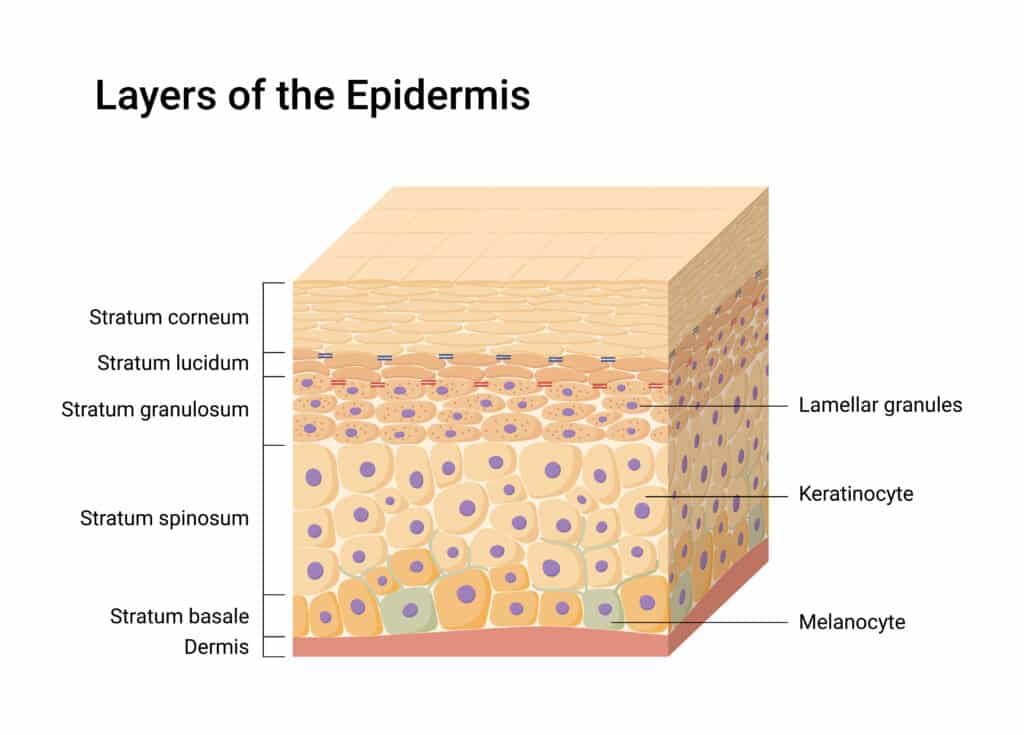
Your skin’s outermost layer is like a brick wall: dead skin cells are the bricks, and lipids are the mortar. Lamellar creams replicate this layered lipid structure with ingredients that resemble skin lipids, such as:
- Ceramides
- Fatty acids (like stearic acid)
- Cholesterol
- Emulsifiers like Olivem 1000 or Montanov 68
When applied, the cream integrates into damaged areas like a patch, helping the skin “fill in the gaps” in its barrier.
DIY vs Professionally Formulated Creams
Blending ingredients at home can produce a basic moisturizer.
But creating a structurally stable lamellar emulsion? That requires:
- Correct emulsifier and co-emulsifier ratios
- Controlled heating and cooling phases
- Proper shear (mixing) forces
- Precision in ingredient polarity and lipid chain length
Professional formulations are engineered to align with the skin. Most DIY creams, while nourishing on the surface, lack this biomimetic sophistication.
Sensory Benefits (It Feels as Good as It Works)
Lamellar emulsions:
- Absorb faster with no greasy residue
- Deliver a long-lasting moisture reservoir
- Provide a soft, bouncy, “cushion” effect on the skin
- Minimize irritation, even for sensitive skin types
It’s not just about science, the experience matters too.
Conclusion: Your Cream Should Speak Skin’s Language
A basic cream says, “Here, have some moisture.” A lamellar emulsion says, “Let me help you rebuild.”
This is not about trendy marketing. It’s a shift in cosmetic science from superficial hydration to structural repair. When a cream mimics the skin’s own architecture, it becomes more than a moisturizer; it becomes a functional part of your skin’s healing process.
Want to formulate creams that go beyond hydration? Learn how to design biomimetic emulsions from scratch in our Emulsion Cream Formulation Guide.
Because mixing oil and water is easy. Mimicking the skin? That’s formulation science.