


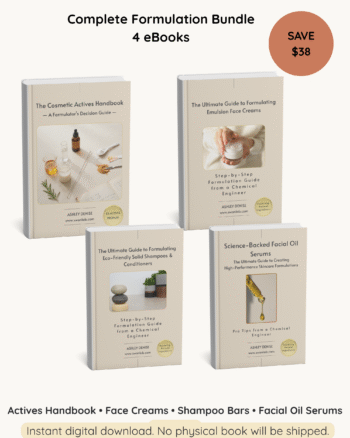
💧 The Ultimate Emulsion Face Cream Formulation Guide
A 340-page science-backed eBook that teaches you how to formulate stable, high-performance emulsion face creams using real cosmetic science. Both Oil-in-Water (O/W) and Water-in-Oil (W/O) systems covered in depth.
⚠️ Read first: This is a formulation training, not a copy-paste recipe collection. You will learn the cosmetic chemistry to design your own face creams, with 10 complete working formulas included as professional starting points. If you only want kitchen-style recipes without theory, this is not the right book for you.
✦ 10 Complete Professional Formulas
Every formula includes full INCI tables, phases, and percentages:
- Anti-Age Cream with Bakuchiol (O/W)
- Calming & Restorative Night Cream with Coenzyme Q10
- Renewal Radiance Night Cream with AHA
- Revital-Eye Cream
- Daily Radiant Niacinamide Cream
- Healing Balm (W/O Emulsion)
- Barrier-Strengthening Face Cream with Ceramides
- Renewing Night Cream with Vitamin A (Retinol)
- ZnO Barrier Cream (W/O Emulsion)
- Prebiotic Moisture Cream
Plus 9 additional starter formulation templates for you to customize: basic moisturizer, mattifying cream for oily skin, lightweight day lotion, brightening cream, soothing cream for sensitive skin, ceramide-rich night cream, and more.
Written by a chemical engineer specialized in cosmetic R&D, this guide is structured the way real product development works: chemistry first, recipe second.
💡 What You Will Learn
- How emulsions actually work and how to choose between O/W and W/O systems
- Matching emulsions to skin needs (oily, dry, combination, sensitive, mature)
- The water phase: purified water types, hydrosols, and 14 humectants (glycerin, hyaluronic acid, sodium PCA, inulin, urea, panthenol, sodium lactate, and more)
- Carrier oils and butters by skin type, fatty acid profiles, oil polarity, oxidation stability
- Waxes, fatty acids, fatty alcohols, thickeners and stabilizers (xanthan, guar, agar, Solagum AX, cetearyl alcohol, stearic acid)
- Esters and silicone alternatives for clean, modern textures
- Active ingredients for specific concerns:
- Antioxidants and vitamins (E, C derivatives, A derivatives/retinoids, CoQ10, niacinamide, panthenol)
- Chemical exfoliants: AHAs, BHAs, azelaic acid
- Skin brightening: alpha arbutin, kojic acid, glabridin, N-acetyl glucosamine
- Barrier strengthening: ceramides, phytosterols
- Peptides, proteins, and amino acids
- Circulation enhancers: caffeine, aescin, menthol
- Anti-inflammatory and anti-aging: bisabolol, green tea, centella, turmeric, bakuchiol, allantoin, licorice
- Essential oils with safety-aware blending tables by skin concern
- Emulsifier selection: natural and synthetic options (Olivem, Montanov, Polawax), the HLB system, practical tips
- Preservation systems for emulsions: natural vs synthetic, how to build a system
- pH balancing and pH adjusters with practical methods
- Production process: equipment for professional and DIY setups, sterilization, step-by-step O/W and W/O workflows
- Soaping effect: why it happens with natural emulsifiers and how to fix it
- Stabilization, storage, and troubleshooting (separation, soaping, pilling, irritation)
- Combining actives in emulsion systems, seasonal adjustments, common user mistakes
- Legal and regulatory considerations for selling skincare products
- Raw material sourcing guidance
📖 Full Table of Contents
Section 1. Introduction
What is an emulsion, why emulsion face creams matter, how to choose and formulate the perfect face cream, how to use this guide
Section 2. The Role of Emulsions in Skincare
Benefits, types (O/W vs W/O), choosing between them, matching to skin needs, combining with other skincare
Section 3. Key Components of Emulsion Face Creams
3.1 Water types and purification
3.2 Hydrosols and floral waters
3.3 Humectants (14 ingredients in depth)
3.4 Carrier oils and butters by skin type, fatty acids 101, oxidation, polarity
3.5 Waxes
3.6 Fatty acids and fatty alcohols
3.7 Thickeners and stabilizers
3.8 Esters and silicone alternatives
3.9 Active ingredients (extensive deep-dive: antioxidants, vitamins, AHAs/BHAs, brightening agents, ceramides, peptides, anti-inflammatory and anti-aging actives)
3.10 Essential oils with safety tables
3.11 Emulsifiers, HLB system, natural and synthetic options
3.12 Preservatives and preservation systems
3.13 pH balancing and adjusters
3.14 Natural and organic ingredient principles
Section 4. Emulsion Face Cream Production Process
Equipment for professional and DIY setups, sterilization, step-by-step O/W and W/O workflows, soaping effect troubleshooting, stabilization, storage, full troubleshooting checklist
Section 5. Formulation Examples
10 complete professional formulas with INCI tables, plus 9 starter recipe templates and “How to Create Your Own Emulsion Formula”
Section 6. How to Use Emulsion Creams
Application techniques, combining actives, seasonal adjustments, common user mistakes
Section 7. Conclusion and Resources
Safety, legal and regulatory considerations, raw material sourcing, next steps
References
🌿 Why SwonLab?
Created by a chemical engineer specialized in cosmetic R&D, this eBook gives you:
- ✔ Real formulation methods used in professional labs
- ✔ Transparent ingredient science explained simply
- ✔ Research-based strategies for both beginners and professionals
- ✔ Lifetime reference for building your own face cream line
No vague advice. No random DIY recipes. Just proven formulation science explained clearly.
🛠️ Product Details
- File format: PDF (instant download)
- Length: 340 pages
- Access: Lifetime download after purchase
- Language: English
- Level: Beginner to intermediate and advanced formulators
Start creating creams that look, feel, and perform like luxury skincare.
Your journey to mastering emulsions starts now.
Who this guide is perfect for
- Beginners who want a clear, structured pathway
- Indie formulators needing stability and regulatory clarity
- DIY creators ready to move beyond hobby-level creams
- Anyone struggling with emulsions that separate, feel waxy, or fail stability
Instant download. Lifetime access. No subscriptions.



Reviews
There are no reviews yet.