
You made a switch to a solid bar, expecting soft and shiny hair, but instead, you ended up with rough, tangled locks that feel like straw.
Many people who try to make or buy their first “shampoo bar” face this exact problem. They often blame their hair type or assume solid products just aren’t for them. But the real culprit is usually the product itself.
There is a fundamental difference between a “hair soap” (made with oils and lye) and a “solid shampoo” (formulated with syndet surfactants). While traditional cold-process soap is wonderful for your skin, it can be disastrous for your hair due to its chemistry.
In this post, we will explain why washing your hair with soap creates that dry, matted texture and why switching to a pH-balanced syndet bar is the only way to achieve professional, salon-quality results at home.
Table of Contents
The Big Confusion: Cold Process Soap vs. Syndet Bars
To the naked eye, they look the same: a solid bar used for washing. However, chemically, they are worlds apart.
- Soap (Cold Process): Created through a chemical reaction called saponification. You mix oils (fats) with a strong alkali (Sodium Hydroxide/Lye). The result is always an anionic soap salt.
- Syndet (Solid Shampoo): Short for “Synthetic Detergent.” These are made by blending solid surfactants (cleansing agents), conditioning ingredients, and oils. No chemical reaction takes place during the molding process.
While soap is natural, “natural” doesn’t always mean “compatible with hair biology.” “Natural” describes origin, not performance. Hair doesn’t care whether an ingredient is natural or synthetic, it only reacts to chemistry.
Want to learn more about the ingredients? If you are unfamiliar with cleansing agents and how they work, check out our detailed guide on Surfactants in Skincare and Haircare to understand the building blocks of a good shampoo.
The Chemistry of Hair: Why pH Matters?
The main reason your hair feels like straw or becomes impossible to comb after using a soap bar comes down to one critical factor: pH Balance.
The Alkaline Effect: Why Hair Becomes “Matted”
The natural pH of your hair and scalp is acidic, sitting between 4.5 and 5.5. In this acidic environment, the hair cuticles (the outer protective layer like roof shingles) lie flat, making hair look smooth and shiny.

Traditional soap, no matter how many luxury oils you add, has a high pH of 9.0 to 10.0 (highly alkaline). When you apply this to your hair, the high pH forces the cuticles to lift and open up.
Repeated exposure to high pH doesn’t just cause temporary roughness. Over time, it increases protein loss and weakens the cuticle structure, making hair more prone to breakage.
This leads to high friction between strands, causing them to catch onto each other. The result? Matted, rough hair that is impossible to comb.
The “Soap Scum” Problem
In addition to the rough texture caused by pH, soap creates another issue in hard water.
When soap mixes with water rich in minerals (calcium and magnesium), it undergoes a reaction forming calcium soap, a waxy, insoluble precipitate known as “soap scum.” This substance sticks to your already open hair cuticles. It is incredibly difficult to rinse off and builds up over time, adding a sticky, heavy feeling to the roughness.
Some people suggest an “Apple Cider Vinegar Rinse” to fix this. While the acid helps close the cuticle, it doesn’t always remove the buildup already stuck to your hair strands.
Acidic rinses can improve slip temporarily, but they do not reverse mineral deposition already bound to the hair fiber.
What is a Syndet Bar? (The Professional Standard)
The solution to the “straw-like” texture is not a transition period; it is switching to Syndet Bars.
Syndet bars are formulated using surfactants originally derived from natural fatty acids (such as coconut or palm), but chemically modified for performance and safety, such as Sodium Cocoyl Isethionate (SCI) or Sodium Lauryl Sulfoacetate (SLSa).
Why are they superior for hair?
- pH Balanced: We can adjust their pH to the perfect 4.5–5.5 range using citric acid or lactic acid.
- Smooth Texture: They keep the cuticles flat, preventing that matted, tangled feel.
- No Residue: They rinse clean, even in hard water.
- Gentle: They cleanse without stripping the hair moisture.
This is the standard used by professional salon brands, and it is entirely possible to make these high-quality bars in your own kitchen.
Why Formulating Your Own Syndet Bar is Better
Once you understand the chemistry, making your own solid shampoo is a game-changer. You are not limited to generic recipes found online that might be too harsh or too soft.
By formulating your own syndet bars, you can:
- Choose gentle surfactants that don’t irritate the scalp.
- Add luxury ingredients like Hydrolyzed Proteins or Panthenol (Vitamin B5).
- Create a hard, long-lasting bar that doesn’t turn into mush in the shower.
Start Formulating Like a Pro
If you are tired of failed experiments, rough hair, and wasting expensive ingredients, it is time to stop guessing and start formulating with precision.
Creating a salon-quality shampoo bar requires understanding the right balance of surfactants, hardeners, and conditioning agents. In our Solid Shampoo & Conditioner Bar Formulation Guide, we break down the science into simple, actionable steps. You will get access to tested formulas that leave hair soft, shiny, and perfectly clean. No vinegar rinse required.
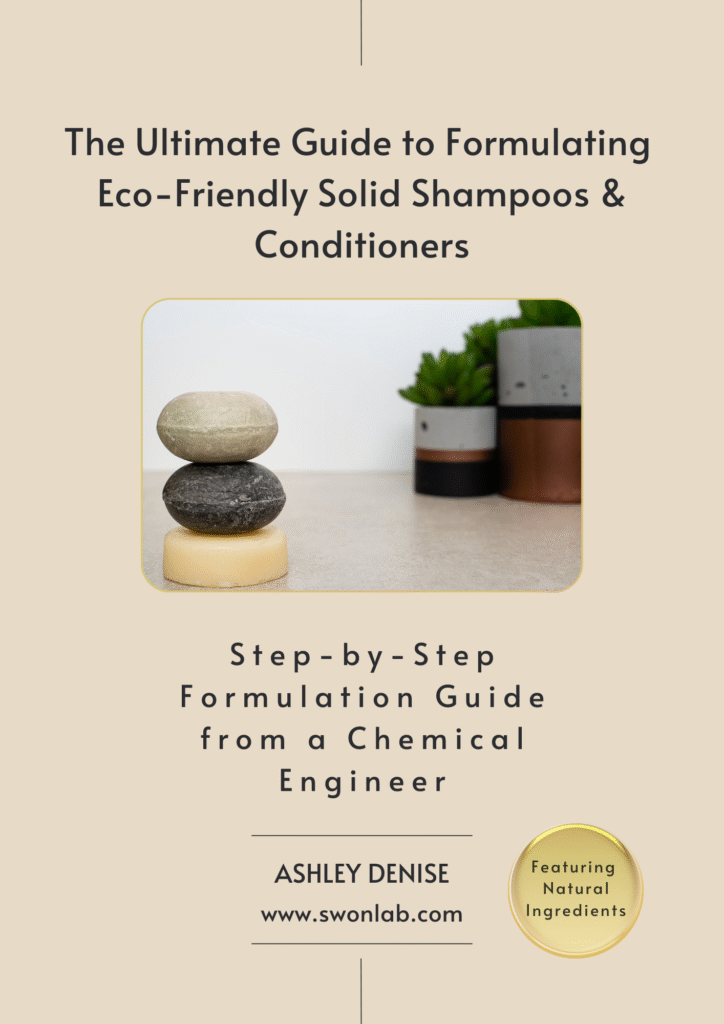
Solid Shampoo & Conditioner Bar Formulation Guide
Create solid shampoo and conditioner bars with confidence.
No more guesswork, failed batches, or endless ingredient research.
Learn the exact methods and pro techniques used by real cosmetic formulators.
Master the science of pH-balanced, syndet (soap-free) solid shampoo and conditioner bars.
This 174-page guide, written by a Chemical Engineer, gives you 7 complete professional formulas with full INCI tables (4 shampoo bars including anti-dandruff, 3 conditioner bars with BTMS-50, Varisoft EQ 65, and AminoSensyl™ HC), ingredient deep-dives (surfactants, BTMS, actives, oils…), and step-by-step process (cold and hot) to stop the guesswork and start creating bars that truly perform.
Beginner-friendly, eco-conscious, and results-driven.