
Table of Contents
What if the oil-free approach is actually making your skin worse?
If you have acne-prone skin, you’ve probably been warned to stay far away from facial oils. It’s a common belief that oils clog pores and cause breakouts. But that’s only part of the story.
The truth is, some oils do clog pores. But others? They can actually help.
Non-comedogenic facial oils are specially chosen because they’re unlikely to block pores. Instead of making acne worse, they can calm inflammation, support your skin barrier, and even help your skin regulate its own oil production.
That means less irritation. Fewer breakouts. And a more balanced, healthy-looking glow.
In this guide, we’ll help you understand what “non-comedogenic” really means. We’ll look at the science behind pore-clogging oils. And we’ll introduce you to the best oils for acne-prone skin. Especially the lightweight, fast-absorbing ones that are backed by both research and experience.
If you’ve been scared to try oils, this is your chance to change the story.
Let’s find out which oils actually deserve a place in your routine.
Why Oils Can Actually Help Acne-Prone Skin
It sounds completely backwards, doesn’t it?
If your skin is already oily and breaking out, why would you add more oil on top of it?
Here’s the thing: not all oil is bad. In fact, some oils can do exactly what your skin needs. They can nourish, calm, and protect, without causing more breakouts.
Many acne treatments focus on stripping the skin. Harsh cleansers, drying toners, alcohol-based spot treatments… They might kill bacteria, but they also damage your skin barrier. This can leave your skin red, irritated, and surprisingly, even more oily.
Why? Because your skin tries to protect itself. If you strip away too much oil, your skin often overcompensates by producing even more sebum. That can lead to a frustrating cycle of dryness, oiliness, and new breakouts.
Facial oils can help break that cycle.
Certain plant-based oils are rich in linoleic acid, a fatty acid that acne-prone skin often lacks. Studies have shown that when your skin is low in linoleic acid, your sebum becomes thicker and more likely to clog pores. But when you apply oils that are high in linoleic acid (like grapeseed, hemp, or safflower) your skin’s oil becomes thinner and flows more easily. This helps reduce congestion and clogged pores.
But that’s not all. Many acne-safe oils also contain anti-inflammatory compounds, antioxidants, and nutrients that promote healing. They can calm redness, fade post-acne marks, and support your skin’s natural repair process.
Think of facial oils as more than just a “moisturizer.” They’re skin-balancing tools. Used the right way, they can:
- Prevent overdrying from harsh acne treatments
- Help regulate excess oil production
- Strengthen your moisture barrier
- Soothe irritation and support healing
What Science Says About That
Before we dive into the meaning of “non-comedogenic,” let’s take a quick look at what the science says about oils, sebum, and acne.
Research supports the idea that certain oils, especially those rich in linoleic acid, can benefit acne-prone skin in several key ways:
1. Linoleic Acid Deficiency and Acne
Acne-prone skin tends to have lower levels of linoleic acid in its sebum, which may lead to clogged pores and inflammation (Downing et al., 1986).
Supplementing with linoleic acid or related oils may reduce acne inflammation and improve lesion counts (Jung et al., 2014).
2. Plant-Based Oils Repair the Skin Barrier
Oils rich in linoleic acid (like sunflower or safflower oil) support skin barrier repair and reduce irritation and redness (Wang et al., 2024).
Linoleic acid also protects skin cells from oxidative damage and supports cellular health under stress (Manosalva et al., 2024).
3. Anti-Inflammatory and Healing Benefits
Some natural plant oils have anti-inflammatory and antioxidant effects that help soothe irritated skin and promote healing (Lin et al., 2017).
4. Balancing Skin Instead of Over-Stripping
Some oils even provide antimicrobial protection and enhance skin’s resilience to acne-causing bacteria (Vaughn et al., 2018).
Conclusion:
When used correctly, oils high in linoleic acid can help regulate oil production, reduce inflammation, and support healing in acne-prone skin – effectively breaking the cycle of dryness and breakouts.
Of course, not every oil is safe for breakout-prone skin. And that’s exactly why the term non-comedogenic matters.
Let’s talk about what it really means and why you shouldn’t trust the label blindly.
Understanding Comedogenicity (and Why the Scale Isn’t Everything)
You’ve probably come across the infamous comedogenic scale: a rating from 0 to 5 that supposedly tells you how likely an ingredient is to clog your pores.
Sounds pretty straightforward, right? But here’s the reality: the comedogenic scale isn’t as reliable or universal as it may seem.
Where It Comes From (and Why That Matters)
The idea of comedogenicity comes from studies in the 1970s and ‘80s, where scientists tested cosmetic ingredients by applying them to rabbit ears or the backs of human volunteers. If clogged pores appeared, the ingredient got a higher score.
Dermatologist James Fulton later published the popular 0–5 comedogenic scale, which many websites still use today.
But there’s a catch: rabbit ears aren’t human skin. In fact, they’re far more sensitive and reactive. And testing ingredients at full concentration on a human’s back doesn’t reflect how they behave in a well-formulated facial product.
So yes, coconut oil might be rated a 4 on the scale. But does that mean a cleanser with 5% coconut oil will wreck your skin? Not necessarily.
Comedogenic ≠ Always Bad
Let’s break down a few important points:
- Skin is personal. What clogs one person’s pores may be perfectly fine for another. Your skin type, barrier health, and even hormones all influence how it reacts to a product.
- Concentration matters. Most comedogenicity tests used ingredients at 100% strength. But in real life, oils are part of a formulation — often used at 5–10%, surrounded by emulsifiers, esters, or surfactants. That completely changes how they interact with your skin.
- Blending changes everything. Even a pore-clogging oil can become more skin-friendly when combined with lightweight oils or rinse-off surfactants. For example, a balm cleanser with comedogenic oils might be fine, because you’re washing it off.
- There’s no legal standard. “Non-comedogenic” is not a regulated term. Brands can slap it on a product based on minimal testing (or sometimes no testing at all). That’s why it’s important to do your own research and patch test.
So… Should You Ignore the Scale?
Not at all. The comedogenic rating can be a helpful starting point, especially if your skin is acne-prone or sensitive. But it’s not the whole story.
Think of it as one piece of the puzzle, not a dealbreaker.
If you’re trying a new facial oil and you’re unsure how your skin will react, start slow. Use it on its own for a few days and see how things go. Don’t judge it based on a number alone.
And most importantly, trust your skin. If something works well for you (even if it’s “comedogenic” on paper) then it’s working. That matters more than any list.
How to Actually Use the Comedogenic Scale (If You Want To)
The comedogenic scale is often treated like the ultimate truth about whether an oil will break you out. But as you’ve seen, it’s more of a rough guideline than a scientific guarantee.
That doesn’t mean you have to ignore it completely. Instead, you can use it as a starting point; one piece of the puzzle that helps you make more informed choices.
If you want to reference comedogenic ratings, here are a few simple tips to make them actually useful:
✅ Look at the whole formulation, not just the ingredient.
An oil rated “3” in its pure form might be totally fine when used at a low percentage or blended with lighter oils.
✅ Consider your unique skin.
Skin that’s very oily, acne-prone, or prone to congestion will often react differently than dry or resilient skin. Patch testing is always your best friend.
✅ Check concentration and context.
Many comedogenicity studies used 100% concentration applied daily. Most products use a much smaller amount, combined with emulsifiers and other ingredients.
✅ Treat ratings as approximate.
Different sources report different numbers. Even among dermatologists, there’s no universal agreement. Use the scale as a reference, not a rule.
✅ Trust your own experience.
If you already know an oil consistently breaks you out, don’t feel pressured to use it, regardless of what the scale says. Your skin’s feedback is more important than any list.
Comedogenic Ratings: What the Original Research Really Looked Like
You’ve probably seen dozens of charts online that claim to tell you exactly which oils will clog your pores. But here’s the truth: many of those tables are simply repeated from blog to blog, without context or reference to the actual studies.
Instead of giving you another oversimplified chart, I want to share a direct glimpse into the work that started it all.
Below, you’ll find excerpts from the landmark paper by Dr. James Fulton, who published one of the first systematic studies on comedogenicity. These tables show the real methods and the original grading scale that have been copied (often without explanation) across the internet for decades.
I encourage you to look at them carefully and consider how much nuance goes into evaluating whether an ingredient might clog pores.
Here’s what you’ll see in the images below:
👉 A description of the experimental method. You’ll see how ingredients were tested on rabbit ears (not human skin), the concentrations used, and exactly how follicular keratosis was graded.

👉 A section of the actual results table, specifically focusing on oils and commonly used skincare ingredients. Notice how the comedogenic and irritancy scores are presented side by side.

I’m sharing these original tables so you can appreciate that comedogenic ratings are just a small piece of a much bigger picture. They can be useful, but they should never be the only factor you consider when choosing skincare ingredients.
If you’d like to read the full paper yourself, you can easily find it online using the reference below.
📄 Reference:
Fulton, J.E. Jr. Comedogenicity and irritancy of commonly used ingredients in skin care products. Acne Research Institute, 1236 Somerset, Newport Beach, CA 92660.
Received September 3, 1989. Presented at the Southern California Section, California Chapter, Society of Cosmetic Chemists, Spring 1989.
Ready to Explore More?
If you’re curious to learn even more about using facial oils safely (without clogging your pores) here are some resources you might love:
✅ Best Facial Oils for Oily & Acne-Prone Skin: Lightweight Picks that Won’t Clog Pores
A practical guide to choosing oils that balance and calm breakout-prone skin.
✅ Facial Oil for Gua Sha: What to Use (and What to Avoid)
Discover which oils pair best with your gua sha practice for glowing skin.
📘 Want to go deeper?
Check out my detailed eBook Facial Oil Serum Formulation Guide below
It includes everything from beginner-friendly recipes to advanced formulation tips, all backed by science and experience.
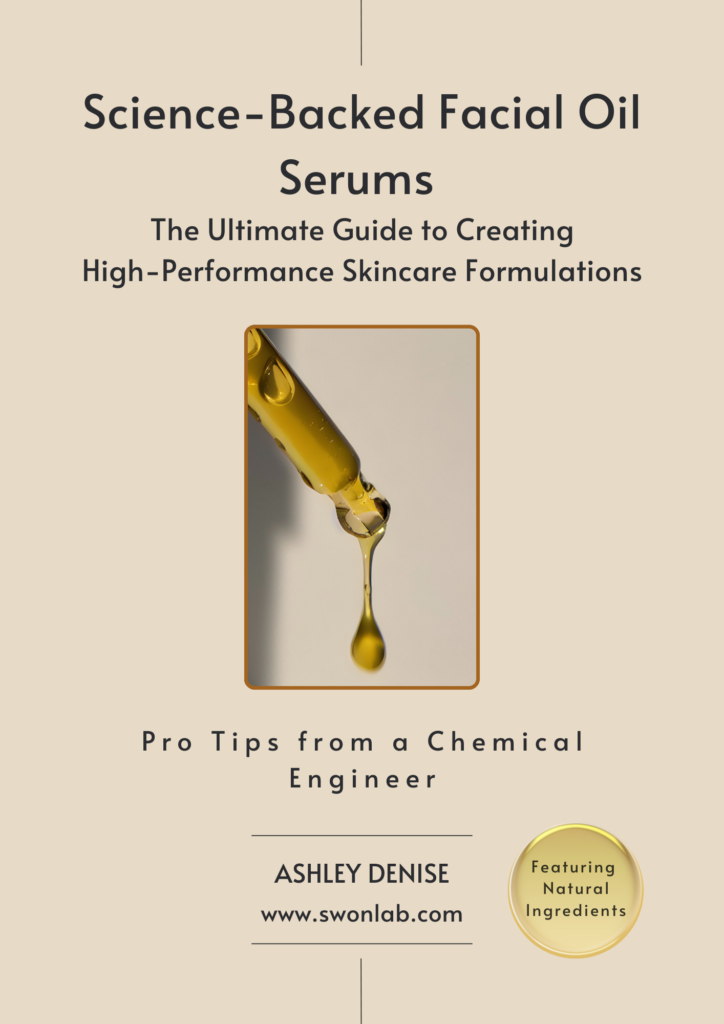
Facial Oil Serum Formulation Guide
Create facial oil serums that deliver real results. No more random mixing, guesswork, or trial-and-error. Learn how professional formulators choose oils, actives, and strategies that actually work.
This 163-page science-backed guide gives you 15 expert-tested formulas (anti-aging with Bakuchiol, two eye serums including CoQ10, Vitamin C facial oil, retinol night serum, ceramide shield serum and more) plus deep-dive ingredient training in carrier oils, essential oils, and oil-soluble actives.
Anhydrous (waterless) system, perfect entry point for new formulators. Written by a Chemical Engineer. Lifetime access.